
By David Akinmola
Nigeria’s total merchandise trade rose to N41.44 trillion in the second quarter of 2026, driven largely by a sharp increase in exports that pushed the country’s trade surplus to N12.60 trillion, according to the latest data from the National Bureau of Statistics (NBS).
The value of goods traded during the quarter increased by 19.13 per cent from the N34.79 trillion recorded in the first quarter, while it was 5.61 per cent higher than the N39.24 trillion recorded in the corresponding period of 2025.
The latest Foreign Trade in Goods Statistics showed that exports accounted for 65.20 per cent of total trade at N27.02 trillion, representing an 18.77 per cent increase from N22.75 trillion in the second quarter of 2025 and a 27.64 per cent rise from N21.17 trillion in the preceding quarter.
Imports, on the other hand, stood at N14.42 trillion, accounting for 34.80 per cent of total trade. The figure was 12.55 per cent lower than the N16.49 trillion recorded in the same quarter last year, although it was slightly higher than the N13.62 trillion recorded in the first quarter of 2026.
Consequently, Nigeria recorded a positive merchandise trade balance of N12.60 trillion during the quarter, reflecting the widening gap between the value of goods exported and those imported.
The development represents a significant improvement in the country’s external trade position, coming amid efforts to strengthen export earnings and reduce pressure on foreign exchange resources.
However, the composition of the export performance continues to raise concerns over the country’s dependence on crude oil and other primary commodities.
Crude oil remained the dominant export commodity during the quarter, with its value put at about N12.91 trillion, accounting for nearly half of Nigeria’s merchandise exports.
The performance also highlighted a mixed picture for non-oil exports, with some categories recording significant increases while agricultural exports weakened. Data from the NBS showed that agricultural exports declined by 36.09 per cent year-on-year, even as exports of raw materials rose sharply by 181.24 per cent.
The trend underscores the continuing challenge of diversifying Nigeria’s export base, particularly as fluctuations in global oil prices and production levels can significantly affect the country’s external earnings.
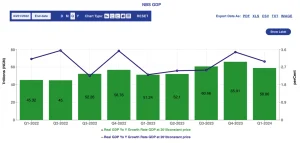
The increase in merchandise trade also comes against the backdrop of broader economic recovery. Nigeria’s real Gross Domestic Product (GDP) grew by 4.43 per cent year-on-year in the second quarter, up from 3.89 per cent in the first quarter and 4.23 per cent in the corresponding quarter of 2025.
For policymakers, sustaining the improvement in the external trade balance would require stronger growth in non-oil exports, greater domestic production and reduced dependence on imported goods.
While the N12.60 trillion trade surplus provides a stronger external position, analysts and industry stakeholders have continued to stress that the long-term benefit will depend on Nigeria’s ability to convert rising export values into broader productive capacity and more diversified sources of foreign exchange.
The latest figures therefore present a mixed picture: Nigeria is earning more from exports and recording a substantially larger trade surplus, but the continued dominance of crude oil shows that the country’s export diversification challenge remains unresolved.