
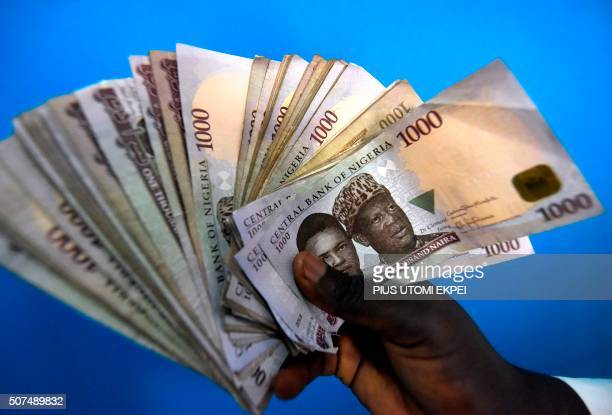
This picture taken on January 29, 2016 in Lagos shows 1000 naira banknotes, Nigeria's currency. - Nigeria's central bank governor, Godwin Emefiele, on January 26 dismissed calls to devalue the naira in his monetary policy committee statement. Instead he chose to continue propping up the currency at 197-199 naira to the dollar and maintain foreign-exchange restrictions. As a result, the naira on the black market is hovering around a record low of 305, fuelling complaints from domestic and foreign businesses who can't access dollars required for imports. (Photo by PIUS UTOMI EKPEI / AFP) (Photo by PIUS UTOMI EKPEI/AFP via Getty Images)
The month-on-month decline indicates a slight moderation in overall liquidity conditions at the start of the year, although money supply remains significantly higher on a year-on-year basis.
Monetary aggregates indicate a mixed trend between domestic and external components of liquidity.
Broad money (M3) fell to N123.36 trillion in January 2026 from N124.4 trillion in December 2025.
Narrow money (M2), which includes currency in circulation and demand deposits, declined similarly, standing at N123.35 trillion from N124.4 trillion.
Net foreign assets (NFA) dropped sharply to N29.6 trillion from N31.5 trillion, reflecting reduced foreign currency holdings and possible pressures on reserves.
Net domestic assets (NDA) rose to N93.76 trillion from N92.9 trillion, signalling continued domestic credit expansion, including lending to government and private sector actors.
Despite the month-on-month contraction, M3 remains above January 2025 levels of approximately N111.11 trillion, reflecting sustained monetary growth over the year.
The movement in money supply comes against the backdrop of evolving monetary policy measures by the CBN.
In September 2025, the Monetary Policy Committee (MPC) reduced the Monetary Policy Rate (MPR) by 50 basis points to 27 per cent, aiming to support economic activity amid easing inflationary pressures.
In November 2025, the MPC maintained the MPR at 27 per cent, adopting a cautious stance to balance price stability with growth support.
This could suggest the January contraction could be due to tighter liquidity management by the apex bank, seasonal adjustments, or more conservative lending behaviour by financial institutions.
The decline in net foreign assets may indicate ongoing adjustments in the external sector, including interventions in the foreign exchange market and reserve management strategies.
The trends highlight the complex dynamics of domestic liquidity, external reserve management, and credit provision in shaping Nigeria’s monetary conditions.
At its 304th meeting of the Monetary Policy Committee (MPC) in February, CBN reduced the Monetary Policy Rate (MPR) by 50 basis points to 26.5 per cent from 27 per cent.
The apex bank also retained the Cash Reserve Ratio at 45.0 per cent for commercial banks and 16.0 per cent for merchant banks.
The Liquidity Ratio was maintained at 30.0 per cent.
The Standing Facilities Corridor was fixed at +50/-450 basis points around the MPR.
The National Bureau of Statistics (NBS) also reported that the headline inflation declined for the eleventh consecutive month to 15.1 per cent in January 2026, reflecting continued price moderation
The January 2026 monetary statistics suggest a measured start to the year, with domestic credit growth partially offsetting external pressures.
Nigeria’s broad money supply (M3) fell to N123.36 trillion in January 2026, compared to N124.4 trillion recorded in December 2025.
The figures are contained in the latest monetary statistics released by the Central Bank of Nigeria.
Broad money, or M3, comprises currency in circulation outside banks, demand deposits, savings and time deposits, as well as foreign currency deposits.