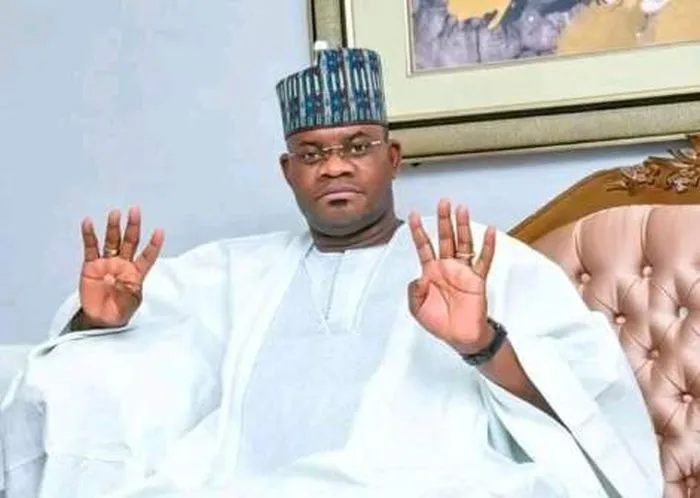
Former Kogi State Governor Yahaya Bello has accused the Economic and Financial Crimes Commission (EFCC) of subjecting him to a political trial rather than genuinely prosecuting an alleged N80.2 billion money laundering case.
The allegation was made by Bello’s legal team during proceedings at the Federal High Court in Abuja, according to reports from the News Agency of Nigeria.
The claim comes amid ongoing cross-examination of prosecution witnesses as both sides seek to strengthen their cases through documentary and oral evidence.
The accusations were raised before Justice Emeka Nwite, while Bello’s counsel responded to submissions made by the EFCC’s legal team.
The case centres on allegations that Bello and others conspired in February 2016 to convert N80,246,470,088.88 allegedly obtained through a criminal breach of trust, contrary to the Money Laundering (Prohibition) Act, 2011 (as amended).
At the resumed hearing, the EFCC’s seventh prosecution witness, a compliance officer with a Commercial bank, was cross-examined on transactions linked to Kogi State local governments.
The questioning focused on whether the financial records before the court directly implicated the former governor in the transactions under investigation.
“Do you know the purpose of those entries or transactions?” Bello’s counsel, Joseph Daudu, SAN, asked.
“No, my lord,” the witness replied.
“No, the defendant wasn’t a local government chairman,” the witness said when asked about Bello’s role.
Pinheiro later rose up and said that in money laundering cases, payments made are usually disguised.
“My lord, there is this casual statement I learnt from my leader (Daudu); that this is a case of money laundering where payments can be made in disguise,” he said.
“Very soon, we will know that this is not a money laundering trial but a political trial,” Daudu replied to Pinheiro in court.
The exchange highlighted the defence’s argument that the evidence tendered so far does not directly link Bello to the local government transactions cited by the prosecution.
The matter was then adjourned to February 5 for continuation of cross-examination.
With the trial now progressing into a detailed scrutiny of financial records, the court is expected to determine the weight and relevance of the evidence presented.
The case against Bello has evolved over several months, marked by public confrontations between the EFCC and the former governor.
The anti-graft agency had earlier declared Bello wanted, citing difficulties in effecting his arrest.
It also accused the Kogi State Government of shielding him by invoking immunity provisions.
Eventually, Bello was arrested and arraigned, while another fraud-related case was also filed against him at the FCT High Court.
The current trial at the Federal High Court represents one of the most prominent phases of the EFCC’s case against him.
Earlier in the trial, the EFCC called Nicholas Ohehomon, a representative of the American International School (AIS), as a prosecution witness. His testimony focused on school fees paid for Bello’s children, which the EFCC alleges were proceeds of crime.
The witness tendered AIS statements of account, admission letters, and payment receipts through EFCC counsel, Kemi Pinheiro, SAN.
He confirmed the children’s enrolment and explained that the school operated a postpaid fee arrangement until graduation.
Bello’s counsel sought to tender a certified true copy of an FCT High Court judgment involving AIS to challenge the EFCC’s claims about the origin of the funds.
Justice Nwite overruled the EFCC’s objection, describing it as pre-emptive, and admitted the document into evidence, noting that its relevance and admissibility would ultimately be determined in the context of the facts pleaded before the court.