
By David Akinmola
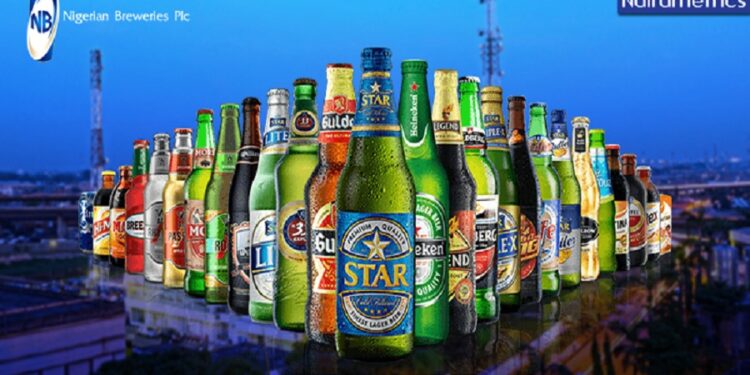
EVEN as inflation continues to erode household incomes and force consumers to cut spending on essential goods, Nigerians spent an estimated N1.41 trillion on beer, malt and spirits in the first half of 2026, lifting the fortunes of the country’s biggest brewers and signalling the resilience of alcohol consumption despite rising prices and changing drinking habits.
Half-year financial results released by Nigerian Breweries Plc, International
Breweries Plc and Guinness Nigeria Plc, which together account for about 90 per cent of Nigeria’s formal brewing market, showed combined revenue of approximately N1.41 trillion between January and June, underscoring the resilience of the alcoholic beverages industry amid a difficult operating environment.
The performance was driven largely by price adjustments implemented earlier this year to offset rising production costs, higher energy prices and inflation, while brewers also benefited from easing foreign exchange pressures and lower financing costs.
A breakdown of the results showed that Nigerian Breweries, the country’s largest brewer, posted revenue of N803.7 billion, representing a nine per cent increase from N738.1 billion recorded in the corresponding period of 2025.
International Breweries generated N342.1 billion, remaining broadly flat compared with N341 billion posted a year earlier, while Guinness Nigeria recorded an 11.8 per cent rise in revenue to N265 billion as it continued to expand its beverage portfolio following its acquisition by Tolaram Group.
The three companies also reported stronger earnings, with combined profit before tax rising by nearly 24 per cent to N269.4 billion, compared with N217.5 billion in the same period last year.
Industry observers attributed the improved profitability to sustained pricing, moderation in foreign exchange losses and lower raw material costs after two years of severe pressure on manufacturers following the naira’s devaluation.
The brewers collectively invested more than N103 billion in production facilities during the period while spending over N130.6 billion on marketing, advertising and brand promotion as competition intensified across beer, stout, malt and ready-to-drink beverage categories.
Despite the impressive financial performance, operators continue to face changing consumer behaviour as younger Nigerians increasingly favour spirits, flavoured alcoholic drinks, wine and non-alcoholic alternatives over traditional lager beer.
Although demand remained resilient, market observer, noted that the industry’s revenue growth was supported more by higher product prices than significant increases in consumption volumes.
Speaking to beer consumers at Bitus Bar in Okota, Lagos, where patrons gathered over bottles of beer yesterday evening, many customers admitted they now spend more on drinks than they did a year ago but still consider social drinking an important part of their lifestyle.
A regular customer, Emmanuel Okonkwo, said rising prices had forced many drinkers to reduce consumption rather than abandon it.
“A bottle that used to cost much less now sells for far more, so most of us simply buy fewer bottles. People still come here after work or on weekends because they need somewhere to relax despite the economy,” he said.
Another patron, Sola Adeyemi, observed that consumers were increasingly switching between beer and spirits depending on affordability.
“Some people now mix things up. If beer becomes too expensive, they go for spirits or smaller drinks that fit their pockets. The economy has changed people’s drinking habits, but it has not stopped people from going out,” he said.
The improved performance marks a significant recovery for Nigeria’s brewing industry after foreign exchange losses and soaring production costs eroded profitability in 2023 and 2024 following the liberalisation of the foreign exchange market.
At the current exchange rate, the combined revenue of the three brewers is equivalent to just over $1 billion, highlighting both the size of Nigeria’s beverage market and the impact of naira depreciation on the industry’s dollar value.
Investors, however, remained cautious despite the stronger earnings. Nigerian Breweries’ shares have declined over the past six months, while International Breweries also traded lower despite its earnings recovery. Guinness Nigeria was the only major brewer to sustain a positive share price performance, supported by improved profitability and a dividend declaration.