
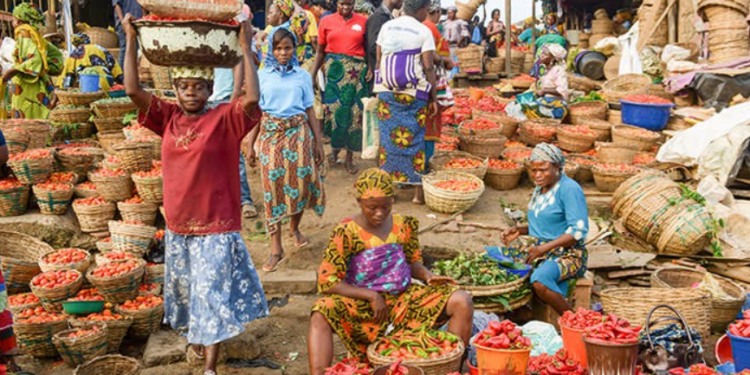
Food prices across Lagos markets eased in January 2026, reversing much of the festive-driven surge seen in December, although cost pressures remain visible in key protein and processed food categories.
This is according to the January Lagos Food Market Survey conducted across Mushin, Daleko, Mile 12, and Oyingbo markets.
While improved supply conditions and softer post-holiday demand helped drive broad price corrections, rising logistics, energy, and import-linked costs continued to push up prices for select food items.
The survey shows that everyday food inflation dynamics in Lagos are becoming increasingly mixed, with welcome relief in perishables like pepper and tomatoes, but persistent strain on household budgets from fish, vegetable oil, and packaged beverages.
The January 2026 Lagos food market survey shows a broad-based decline in food prices compared to December 2025, signaling a post-festive correction across major markets.
Out of the 68 food items tracked, the majority recorded price drops, reflecting improved supply flows and normalization of demand after the holidays.
Out of 68 items tracked, 49 declined in price, 15 increased, and 4 remained unchanged, meaning 72.4% of items became cheaper, 22.1% rose, and 5.9% were flat month-on-month.
Seven out of every ten items either declined in price or stayed the same, reversing the sharp increases recorded during the December festive period.
National Bureau of Statistics data shows headline inflation eased to 15.15% year-on-year in December 2025, while food inflation declined to 10.84% year-on-year and contracted by 0.36% month-on-month.
Despite the overall easing trend, Lagos shoppers continued to experience uneven price movements at the point of purchase, with sharp contrasts between perishables and processed or protein-based foods.
Food prices in Lagos surged in December 2025 as holiday demand, logistics bottlenecks, and seasonal supply constraints combined to push market prices higher.
This seasonal spike is a recurring feature of Nigeria’s food economy, particularly for perishables and festive-linked consumption items.
December price pressures were driven by increased household consumption, tighter transport availability, and higher energy costs during the holiday period.
As markets reopened fully in January, improved haulage from production zones and renewed competition among wholesalers supported price normalisation.
Lagos State food inflation eased to 12.5% in December 2025 from 13.6% in November, reflecting the early signs of moderation captured more clearly in January market prices.
However, structural cost drivers such as diesel prices, cold-chain logistics, and import-dependent inputs continue to limit how far prices can fall.
While sector-wide inflation eased, 15 food items in Lagos posted notable increases in January 2026, with consumers in Mushin, Mile 12, Daleko, and Oyingbo feeling the pinch on several fronts:
Leading the pack was horse mackerel (Kote) fish, which jumped sharply from December’s price of N4,600 to record a 73.91% increase of N8,000 in January.
A 50kg bag of yellow garri rose by 25% to now sell for an average of N25,000 in January from the previous average of N20,000.
2.6litres of Poweroil brand of vegetable oil increased by 13.64% to sell for N12,000 from N10,560 that it sold for in December 2025.
A 350g of Ovaltine refill beverage rose by 7.69% to N3,500 from N3,250, while the tin pack increased by 6.67% to sell for N4,800 in January 2026 from N4,500 in December 2025.
Frozen chicken laps also saw a mild uptick of 7.27%, selling for an average of N59,000 in the review month.
Milo refill (450g): up 4.57%, from N3,500 to N3,660
Bournvita refill (500g): up 2.22%, from N4,500 to N4,600
Melon (egusi): up 2.08%, from N240,000 to N245,000
Golden penny noodles (carton): up 1.88% from N8,500 to N8,660
120g Indomie noodles (carton): up 1.28% from N15,600 to N15,800
Traders attribute the surge in PowerOil to rising costs of repackaging and transport after the holidays, while processed cocoa beverages rose because promotional discounts ended after seasonal sales.
Fish sellers report that cold-chain diesel, lower catches and import exposure contributed to the increase in the price of proteins.
January brought broad price reductions across 49 items, largely driven by post-holiday supply normalization, improved haulage from production zones, and seasonal harvest inflows. For many Lagos residents, this brought welcome relief.
Pepper recorded the highest price declines as a big bag and medium bag dropped by 52.9% and 46% respectively, selling for an average of N40,000 from N85,000 and N27,000 from N50,000.
Tomatoes a big basket of round-shaped and oval shaped tomato reduced by 42.3% and 40% respectively to sell for N30,000 and N21,000 from N52,000 and N35,000 respectively.
A big basket of potatoes likewise recorded a 22.2% decline to sell for N35,000 in January 2026 from the N45,000 in December 2025.
Furthermore, a 50kg bag of white garri dropped 20% from N30,000 in December 2025 to N24,000 in January 2026.
Price declines also reflected in the price of yams as a 0.9kg of Ayoola poundo yam flour dropped by 11.76% to sell for N3,750 from N4,250 recorded in December 2025, and a medium-sized tuber of yam reduced to N4,000 from N4,500, a 11.11% reduction
Oloyin beans (50kg): down 10.77%, from N65,000 to N58,000
Local palm oil (25 litres): down 10.14%, from N69,000 to N62,000
Dano refill milk (350g): down 10% from N3,500 to N3,150
Bonita pasta (500g): down 10% from N1,500 to N1,350
Honeywell wheat (1kg): down 10% from N1,500 to N1,350
Other staples like bush mango (ogbono), mamador vegetable oil, short grain rice (Royal Stallion), etc., also softened by double digits as rural supply chains stabilized and demand from festive hosting abated.
Overall, traders reported that wholesale competition in early 2026 has returned to pre-holiday norms, allowing these price corrections.
A small but noticeable group of about 4 items remained virtually unchanged from December into January, ranging from minimie noodles, titus (mackerel) fish, Lipton Yellow Label tea and a bi-size tuber of Abuja yam, whose supply contracts and retail pricing are less sensitive to short-term seasonal swings.
She explained that seasonal catch fluctuations and higher ice/cold-chain costs have tightened available stock, pushing prices higher. “We are buying less from the beach because fuel for freezers and transport is still costly.”
“Although the price of white garri was high, the yellow garri surprisingly was on the high side, and there is no specific reason for it aside from the high cost of transportation from the Southeastern part of the country.” “Now we have improvised to reduce the quantity to 20kg for N17,000 instead of the usual 50kg for N25,000, but this didn’t make it any better.”
She attributed increases in prices of vegetable oil and beverages to the end of promotions and bonuses after the festive period. “Most of the prices of cocoa beverages increased in price because most brand ran promo and discounts during the festival.”
She was excited about the drop in price of pepper, tomatoes, onion. “Thanks to cheaper peppers, tomatoes and onions, I can conveniently reduce the prices for stews and jollof rice and still make my profit.”
She said, “The price of staple food items is now cheaper, and that makes it easier to cook a good meal for the family now, but prices of beverages are so expensive now, and this forms part of the kids’ daily meal and that has tightened my weekly budget.”
The Food Price Watch is a monthly market survey tracking the prices of major food items across Nigeria.
This report specifically covers four key markets in Lagos State: Mushin Market, Daleko Market, Oyingbo Market, and Mile 12 Market.