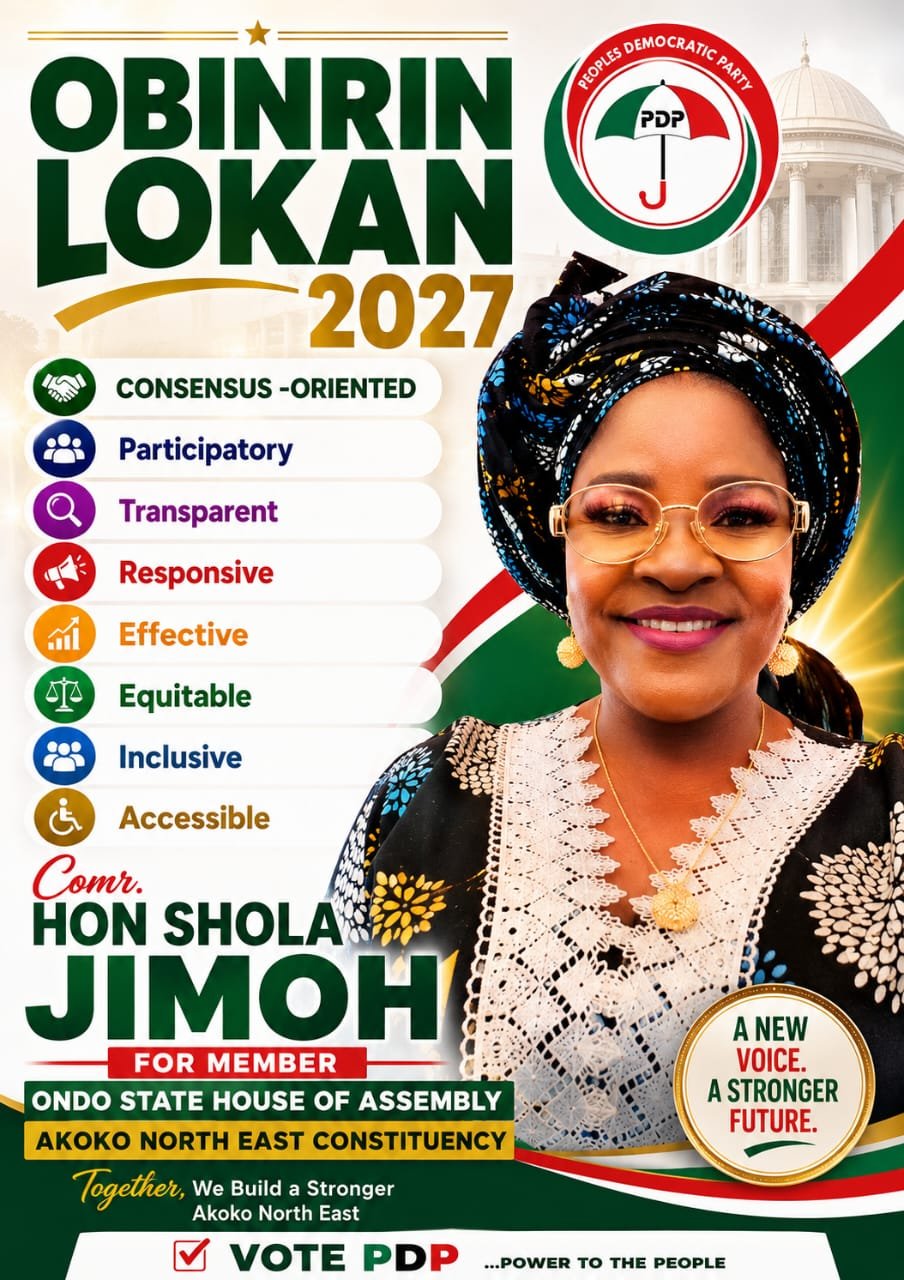
HON. Shola Jomoh
With political activities gradually gaining traction ahead of the next electoral cycle in Ondo State, the conversation in Akoko North East is increasingly turning toward the emergence of new-generation leaders with deep grassroots connections.
Among those drawing attention is Shola Jimoh, a community mobiliser and advocate of inclusive governance whose growing profile is beginning to resonate across political and social blocs within the constituency.
A native of Ikare-Akoko, Jimoh hails from the Orunko Odegbode Okelede family in Ekan, a background her supporters say has shaped her strong attachment to community values, service, and collective progress. Over the years, she has cultivated a reputation for accessibility, philanthropy, and active engagement in local initiatives aimed at improving livelihoods and strengthening social cohesion.
Her educational journey reflects a steady pursuit of personal development.
She began at AUD School IV, Ekan Ikare, before proceeding to Mount Carmel Girls’ Secondary School, Ikare-Akoko.
She later obtained an Ordinary National Diploma in Banking and Finance from The Polytechnic Ibadan in 2010, and a Higher National Diploma from Rufus Giwa Polytechnic, Owo in 2014.
Jimoh’s exposure to leadership and administration was further shaped during her service year under the National Youth Service Corps in Otukpo, Benue State, between 2015 and 2016.
During this period, she served as Financial Secretary of the Federal Road Safety Club and obtained professional certification from the Institute of Management Leadership and Productivity Development (IMLPD), experiences that supporters say broadened her administrative competence and civic orientation.
Her political engagement dates back to her student years, when she emerged as Vice President of the National Association of Ondo State Students (NAOSS), Owo Chapter, in 2014. Since then, she has maintained a consistent presence in political organising, holding strategic roles across multiple platforms.
These include serving as the Vice Chairman PDP Akoko North East Local Government, State Coordinator of the Jagabanist Nationwide Support Group, Local Government Coordinator for SWAGA for Women, and membership of the Progressive Young Women Forum. She is also the Convener of Bunmi Tunji-Ojo Patriotic Front (BPF), a platform focused on political mobilisation and policy advocacy within Ondo North.
Political observers note that her involvement across these structures has not only strengthened her organisational capacity but also positioned her as a bridge between party leadership and grassroots supporters, particularly among women and youths.
Beyond partisan engagement, Jimoh’s appointment with the United Nations International Peace Council (Nigeria Chapter) underscores her interest in peacebuilding and conflict resolution. Analysts say this exposure adds an international dimension to her profile, reinforcing her advocacy for stability as a prerequisite for development.
In a political environment where trust deficit and voter apathy remain key challenges, her supporters argue that her style of politics, marked by direct engagement, inclusiveness, and community presence, offers a departure from conventional approaches.
They further point to her consistent outreach across religious and social divides as a reflection of her commitment to unity in a culturally diverse constituency.
Speaking on her aspiration, Jimoh emphasised the need for responsive governance that prioritises people at the grassroots.
“Leadership must be about service, accountability, and inclusion. Our people deserve representation that listens, understands their needs, and delivers practical solutions that improve everyday life,” she said.
She added that her vision is anchored on strengthening local institutions, promoting youth empowerment, supporting small-scale enterprises, and ensuring that women play a more active role in governance and decision-making processes.
With increasing calls for gender balance in Nigeria’s political landscape, her candidacy is also being interpreted as part of a broader push to expand opportunities for women in leadership, particularly at the sub-national level, where representation remains limited.
As the political space in Akoko North East begins to take shape, stakeholders say the coming months will test the strength of grassroots structures, alliances, and voter sentiment.
For many observers, however, the emergence of figures like Jimoh signals a gradual but notable shift toward a more participatory and inclusive political culture, one that could redefine leadership expectations in the constituency.